
Herringbone carpet works on stairs either way. As a runner, it leaves a border of painted or timber stair showing on each side and gives the staircase a tailored look. Fully fitted, it covers every tread from wall to wall. Many of our customers choose a bit of both: the landing fully fitted and the stairs made into a runner in the same herringbone.
There are plenty of herringbone staircases in our portfolio. Here is how we help people decide which way to fit it, with some of the herringbone stairs our own team has fitted across North London.
A herringbone runner, with the stair showing
A runner is a piece of carpet running down the middle of the stairs, with some of the stair left showing either side. We recommend a border of at least 100mm and up to 150mm, and every runner is made to order, so it can be cut to any width.
A runner suits a staircase that is worth showing off. Painted risers and strings, a stained oak tread or a Victorian staircase with turned spindles all look better with a frame of timber around the carpet. The herringbone then reads as a clear band leading up the stairs.
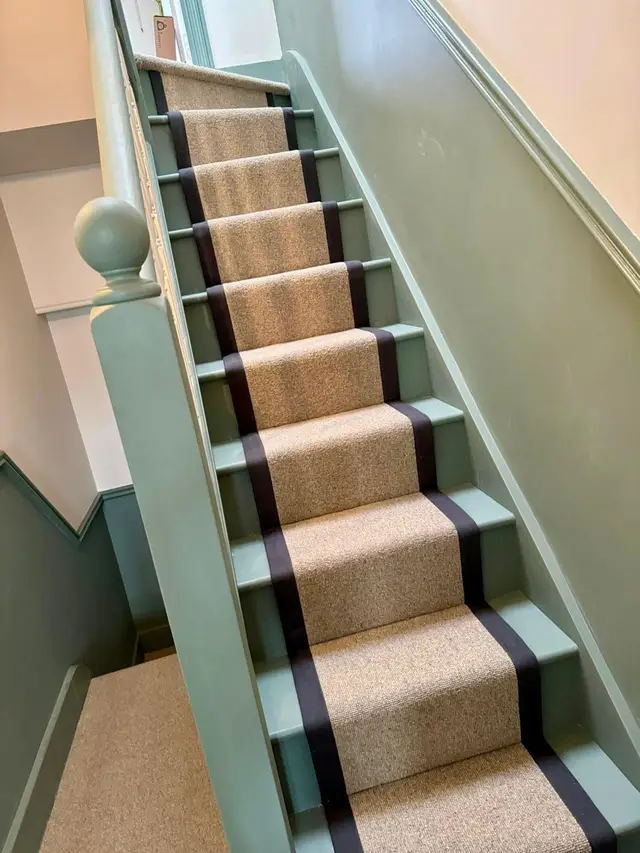
Each runner is finished along its edges. A whipped edge is yarn stitched over the edge, usually in the same colour, so it blends in. A taped edge is a fabric tape with about 50mm showing, often in a contrast colour, which outlines the pattern. Most of the herringbone runners in our portfolio have a taped edge, in charcoal, black or a natural tone.
If you are working out a budget, our guide to what a stair runner costs sets out Russell’s guide prices.
Fully fitted herringbone, wall to wall
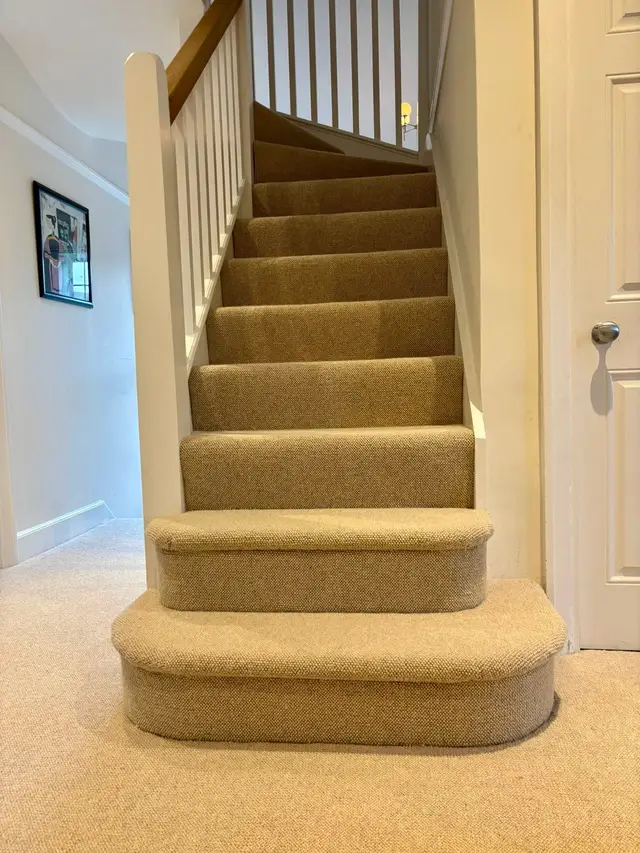
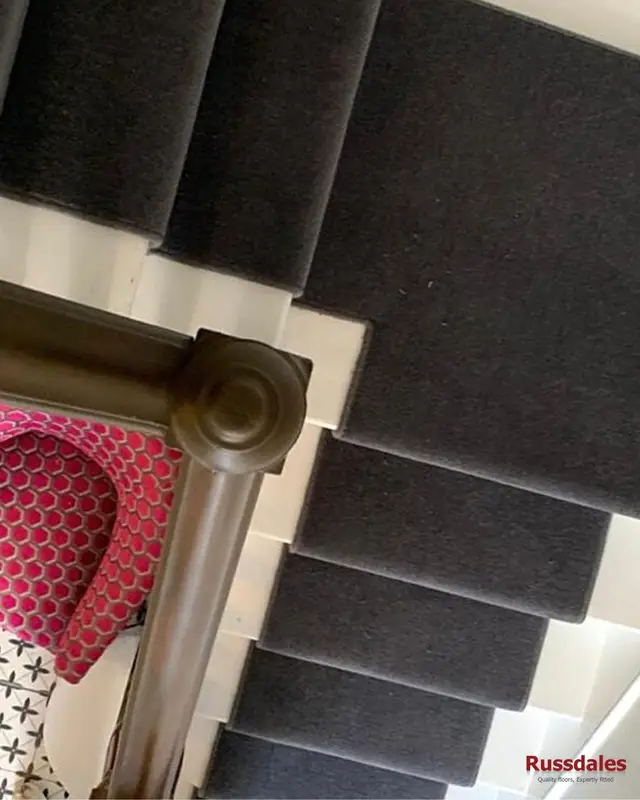
Fully fitted means the carpet covers the whole tread and riser, edge to edge. It is the better choice when the stairs are not worth showing, for example old treads with marks you would rather hide, or when you simply want carpet across the full width of every step.
It also suits a herringbone that you want to read as one continuous floor, from the hall up to the bedrooms. The pattern still has to be kept square on every step, so the fitting takes as much care as a runner.
The best of both: landing fitted, stairs as a runner
This is one of the combinations we are asked for most. The same herringbone goes wall to wall on the landing, and on the stairs it is cut and made into a runner with a taped edge. The landing feels finished and warm underfoot, while the staircase keeps its painted or timber border.
On Firs Lane in N21, the owners chose Fibre Flooring herringbone in Dapple. We fully fitted the top stairs and the landing, then made the bottom staircase into a runner with a double fabric edge.
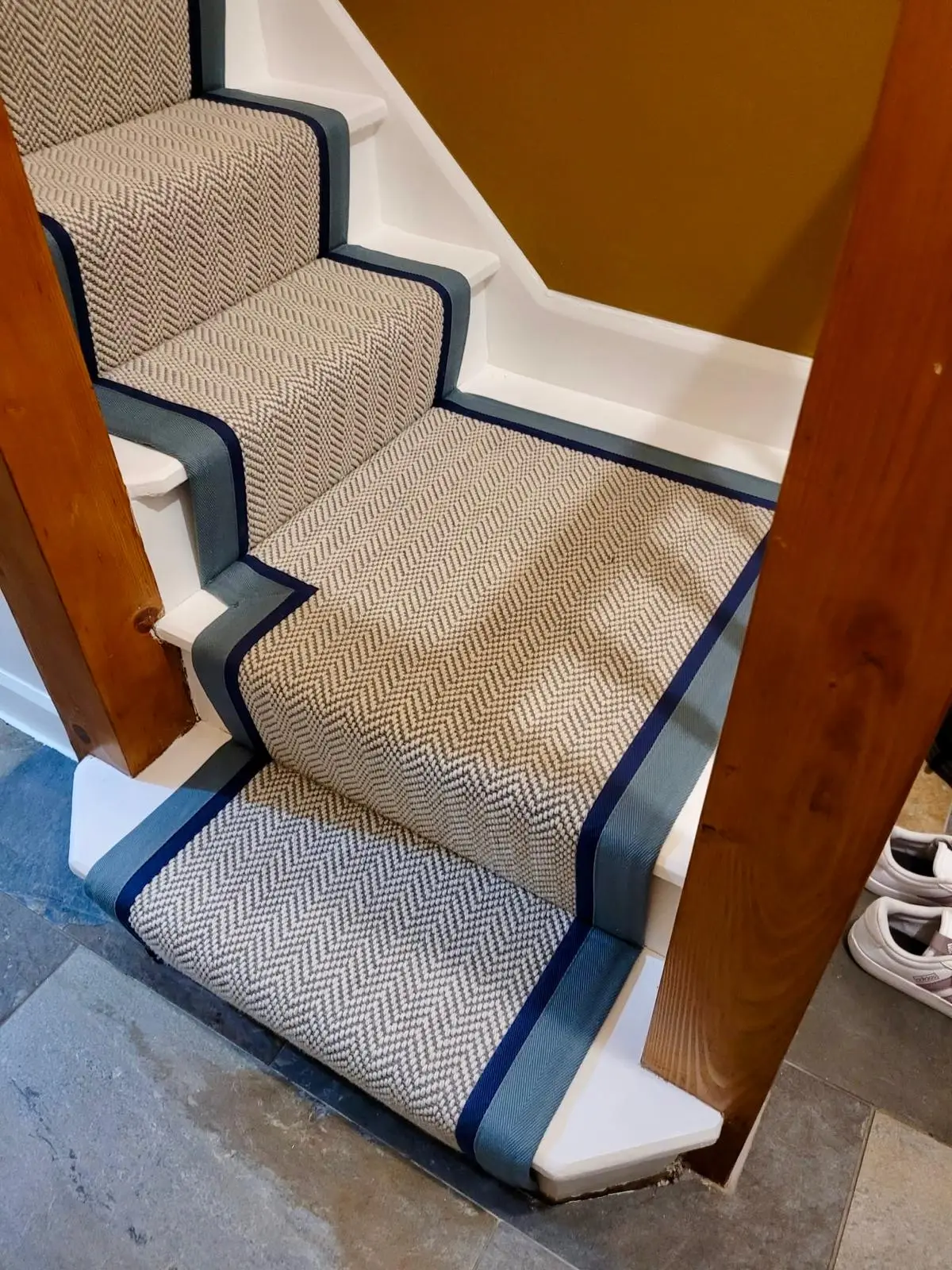
Fibre Flooring herringbone in Dapple, top stairs and landing fully fitted and a runner below with a double fabric edge, Firs Lane, N21. See the job, Ref 13191
Brockway’s Gatsby herringbone in Moonlight was fitted the same way in another North London home: wall to wall on the landing, and a runner on the stairs with a black fabric edge that gives the pale pattern a sharp outline.
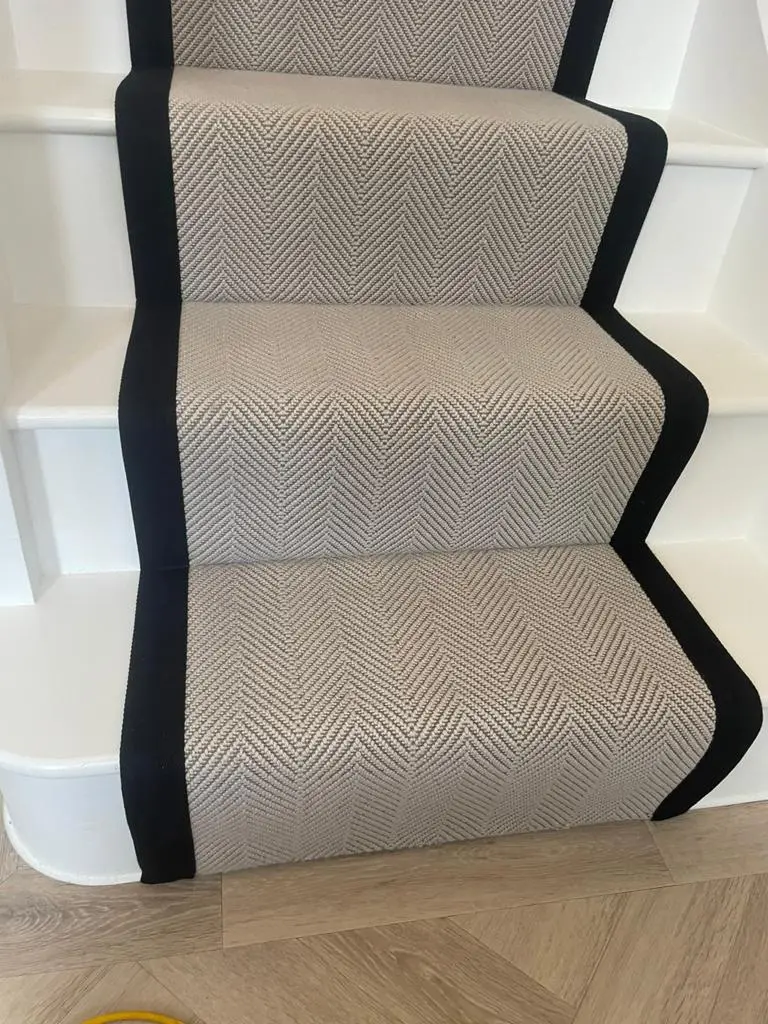
Brockway Gatsby herringbone in Moonlight, landing fully fitted and the stairs made into a runner with a black edge. See the job, Ref 12419
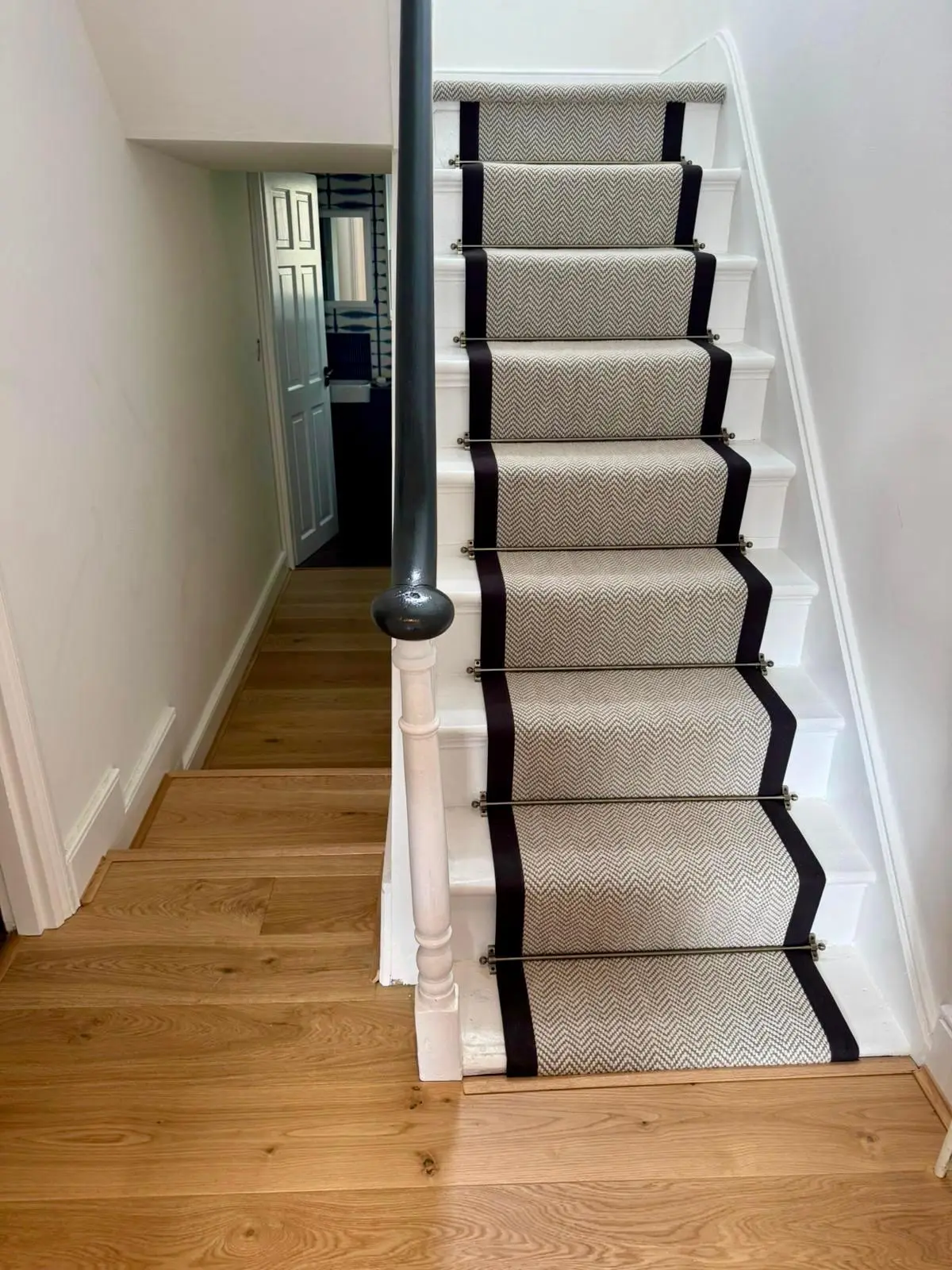
In Winchmore Hill, a Fibre Flooring flatweave herringbone in Luna went wall to wall on the landing, with the stairs made into a runner with a charcoal taped edge and Homepride rods in satin nickel. And in the house in N4 at the top of this page, we made Fibre Flooring herringbone in Dapple into runners for four flights of stairs, with every landing fully fitted, a charcoal taped edge and antique brass Jubilee rods.
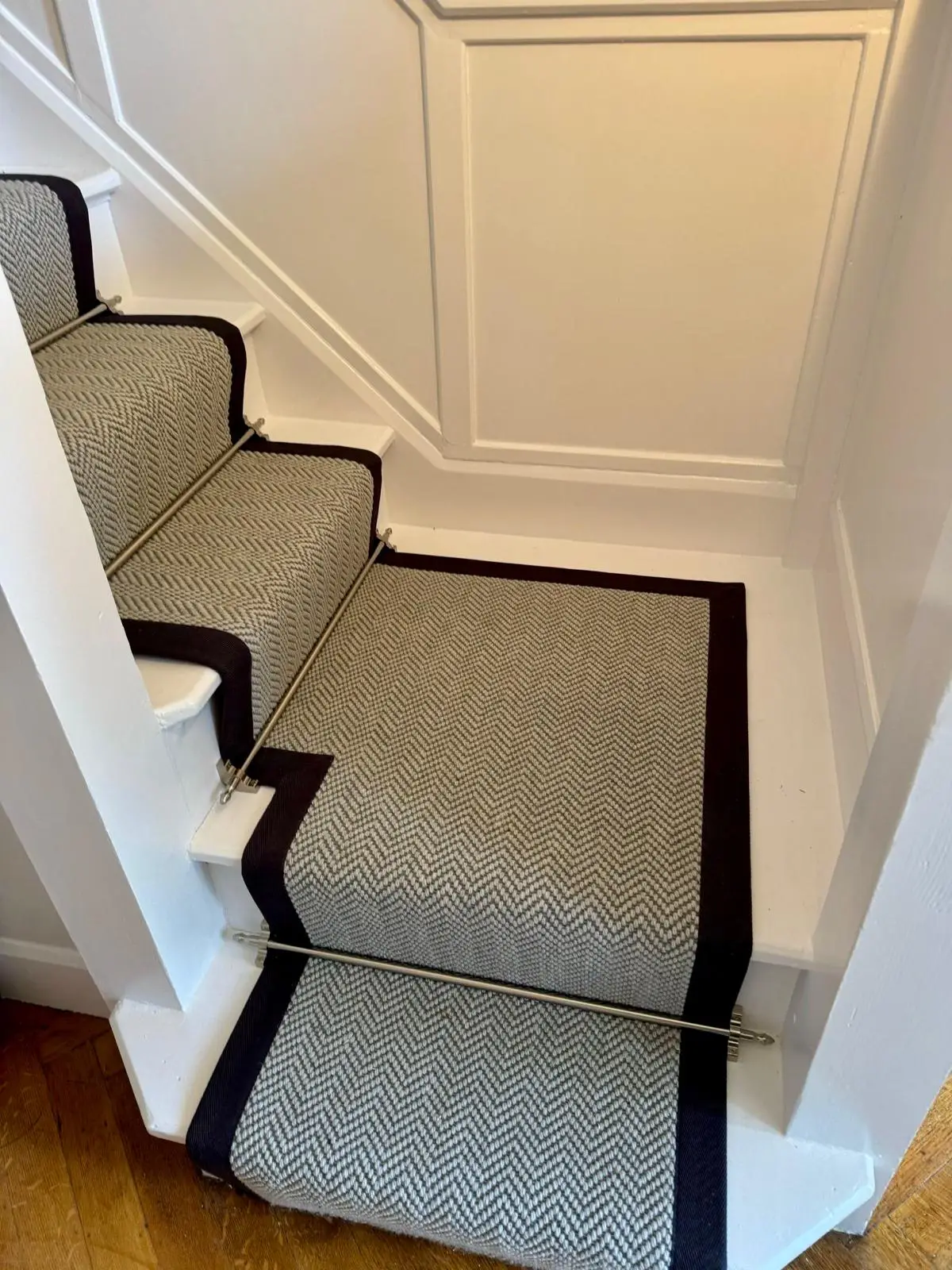
Fibre Flooring flatweave herringbone in Luna, landing fully fitted, runner with a charcoal taped edge and satin nickel rods, Winchmore Hill, N21. See the job, Ref 13347
Flatweave herringbone needs a specialist fitter
Many herringbones are flatweaves. A flatweave is woven very flat, which is exactly why the zigzag shows up so crisply. It also means the carpet has very little give. It cannot be stretched into place to hide a mistake, so each stair has to be measured, the runner cut and bound to the exact width, and the pattern kept straight from the bottom step to the landing.
That is specialised work. We use our own in-house fitters, never subcontractors, and they have fitted herringbone flatweaves on straight flights, quarter landings and multi-storey staircases. If your stairs turn, we template the turn on a separate visit first, so the runner can be made to follow it.
Which way suits your staircase?
A few questions usually settle it:
- Are the treads and risers worth showing? If yes, a runner. If not, fully fitted.
- How does the landing connect to the bedrooms? If the landing is large or open, fitting it wall to wall in the same herringbone often looks best.
- Do you want rods? Rods only go with a runner on the stairs. They are decorative, as the runner is held by grippers and underlay, but they add a finishing detail.
- What edge? A taped edge in a contrast colour frames a herringbone well. A whipped edge keeps it quieter.
Herringbones we have fitted come from Fibre Flooring, Brockway’s Gatsby and Lakeland ranges, and Alternative Flooring’s Wool Icon. You can see the samples in the showroom, in colours from Chalk and Luna to Dapple and Moonlight.
Come and see the herringbones with Russell
Bring a photo of your stairs and landing to a free design consultation with Russell in our showroom at 774 Green Lanes, Winchmore Hill, N21 3RE. He will show you herringbones as runners and as fitted carpet, help you choose the edge and talk through what it will cost. Book your consultation or call 020 8360 1836.