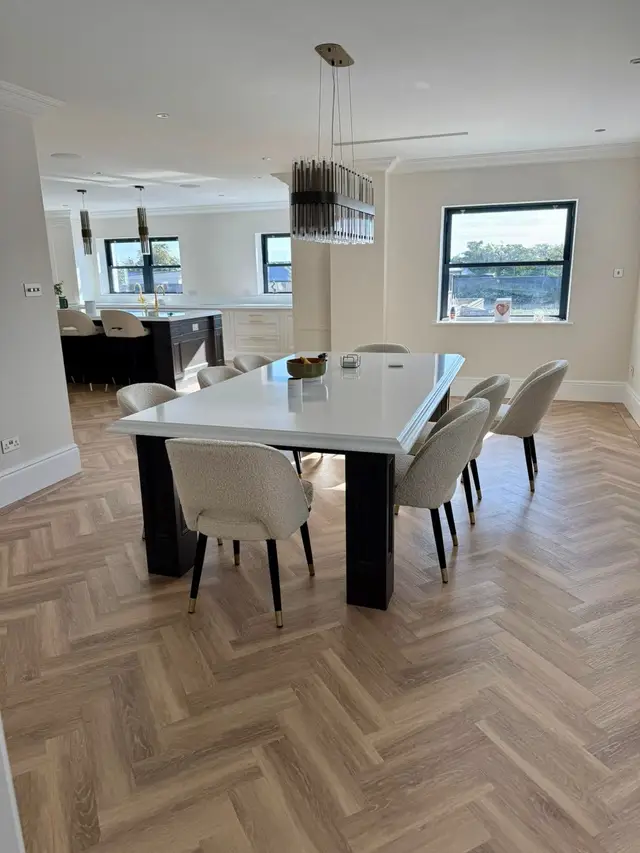

Screed, in our trade, is a liquid smoothing compound poured over a floor to make it flat and smooth. It goes over a concrete or sand and cement base, fills the small dips, bumps and marks, and dries to a layer about 3mm thick. Amtico and Karndean are thin floors that are stuck down, so they need that smooth surface to stick to. Without it, every flaw underneath would show through in time.
Two things people call screed
You may hear the word used for two different layers, which is where the confusion starts.
The builder’s screed is a sand and cement layer laid over a concrete slab, much thicker than ours. You will find one in most new extensions. It makes the floor level and strong, but its surface is rarely smooth enough to glue a vinyl floor straight onto. There are trowel marks, small ridges, patches and the odd hollow.
Our smoothing screed is the thin layer we pour on top. It is a liquid compound, so it flows out over the floor and settles flat, and it dries to about 3mm. You may also hear it called a smoothing compound or a levelling compound. This is the screed we mean when we say a floor needs screeding before Amtico.
Why Amtico and Karndean need a smooth base
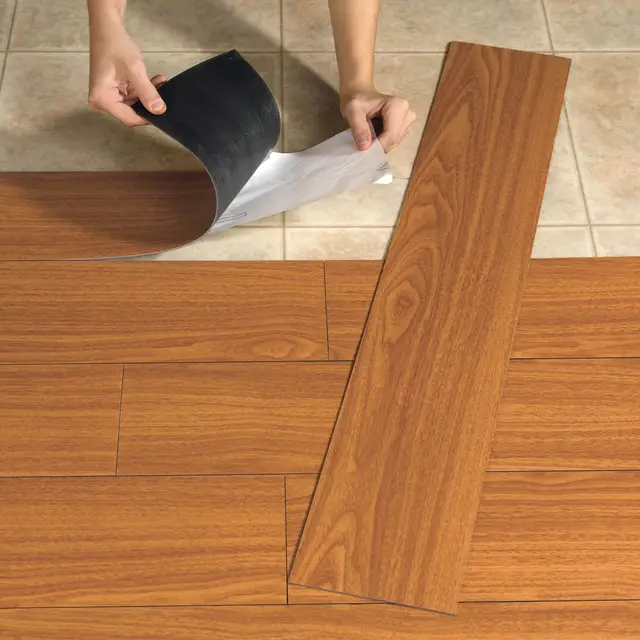
Amtico is a luxury vinyl tile, or LVT: PVC tiles and planks that look like wood, stone or ceramic. Karndean is the same kind of floor. Both are thin and flexible, and most of their ranges are glued down to the subfloor rather than laid over an underlay.
That has two consequences. First, the adhesive needs a clean, sound, smooth surface to grip. Second, a thin floor follows whatever is under it. A bump, a dip or the edge of an old tile will slowly show through the surface, and the light from a window or patio door will pick it out. A smooth screed takes all of that away, so the new floor sits completely flat.
Carpet is different. It goes over underlay and gripper, which take up small unevenness, so a carpet rarely needs a screed. Laminate and wood floors usually float over an underlay too, although they still need a floor that is flat.
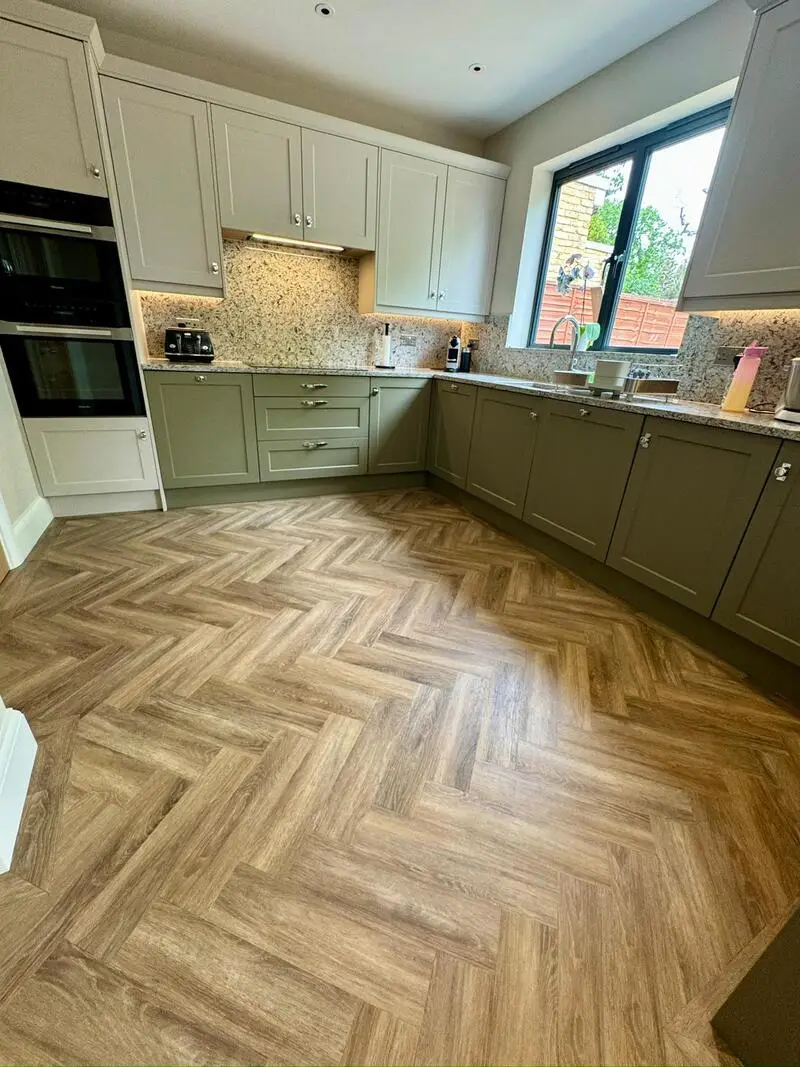
The kitchen in our main photo, in Woodcroft, N21, is Amtico Signature Darley Oak in a large herringbone with a plank-on-edge border. Our fitters prepared the subfloor carefully before a single plank went down, because a patterned floor like this needs a truly flat base (Ref 13578).
A job that needed more than one layer
One North London kitchen shows how the preparation can build up. The job started with removing the old floor. Then came a screed, then a DPM, then a final screed, and only then did the Amtico Spacia Mirrus Cotton planks go down.
A DPM is a damp-proof membrane. It goes on when a concrete floor needs protecting from moisture coming up from below, because damp and floor adhesive do not mix. The final screed then gives a fresh, smooth surface over the top. It is more work than a simple screed, but it is the difference between a floor that lasts and one that lifts.
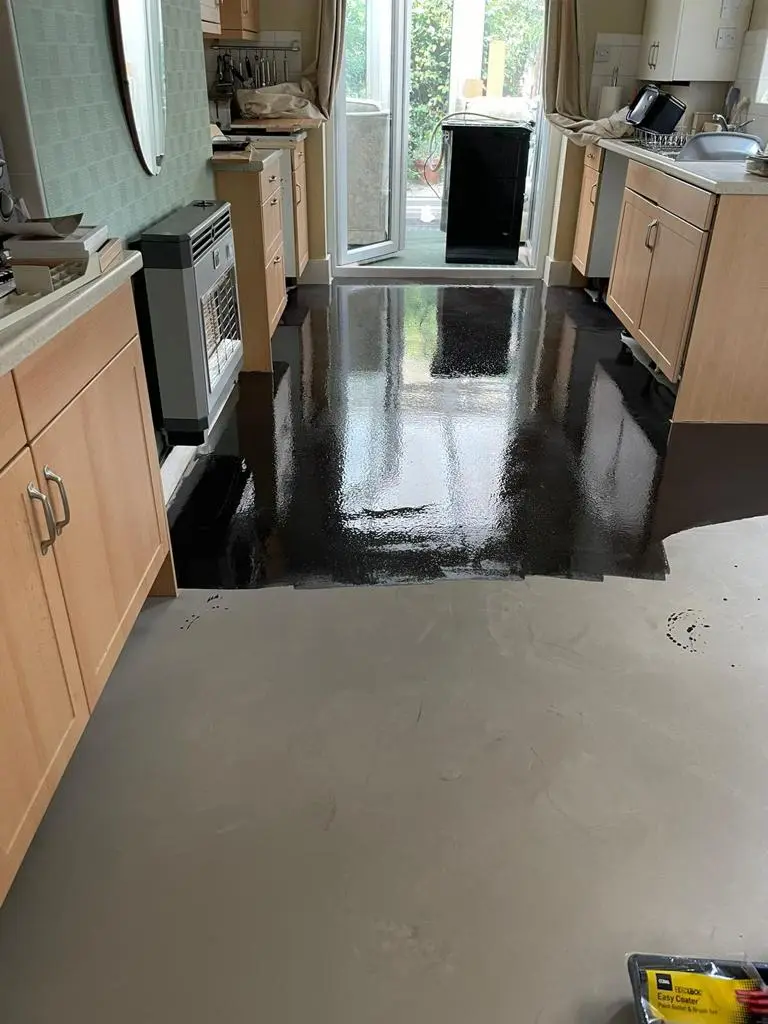 Part way through the preparation in a North London kitchen, with the old floor up and the new layers going down before the Amtico. See the job, Ref 12491
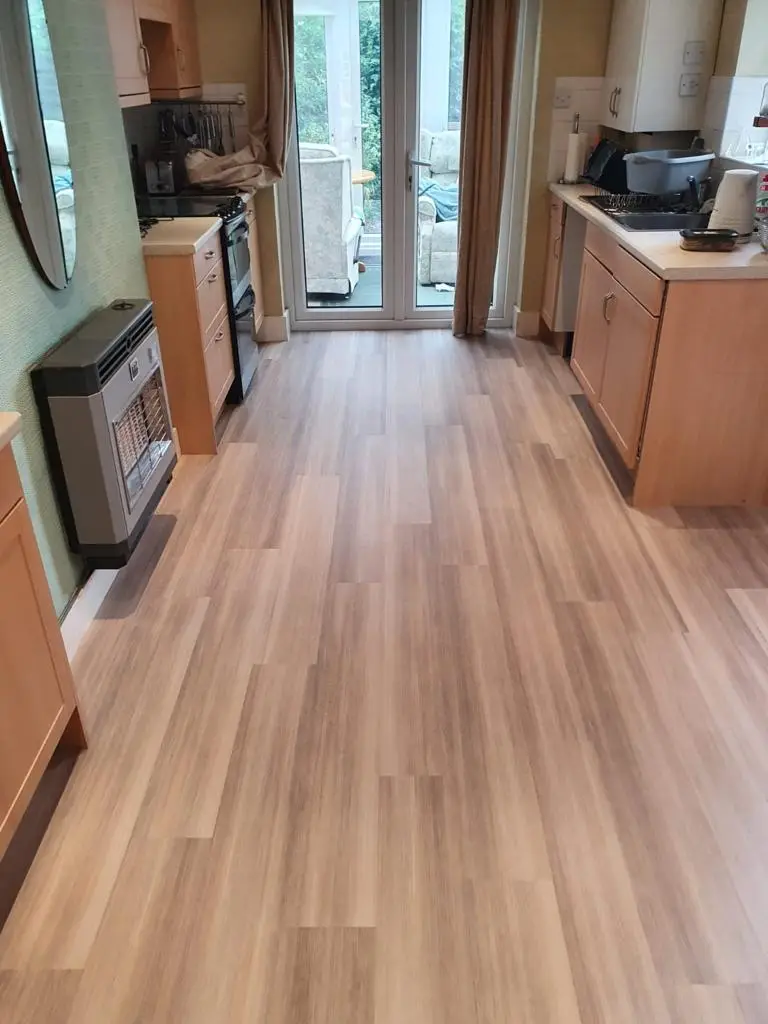 The finished floor: Amtico Spacia Mirrus Cotton planks in the same kitchen. See the job, Ref 12491
What about timber floorboards?
We do not screed over floorboards. Timber floors move a little as you walk on them, and a thin layer of compound is not the answer there. Instead we fit plywood boards over the floorboards, fix them down, then fill the joints between the sheets and sand them smooth. We call that a feather finish, and it gives Amtico the same flat base a screed gives it on concrete.
We explained the ply side in preparing uneven floorboards for new flooring, and the whole fitting process in how we fit Amtico. Many houses have both: timber floors in the original rooms and concrete in the extension. We prepare each one to suit, so a single floor can run through both.
When a screed is not the answer
Not every job needs one. On one Amtico Spacia Honey Oak floor in North London we used a Jumpax subfloor system instead, an alternative to traditional screeding that gave the floor a suitable, stable base without it. Some Amtico ranges, such as Click Smart, are click systems that float rather than being glued, although they still need a flat floor. Russell will tell you which approach suits your room when we survey it.
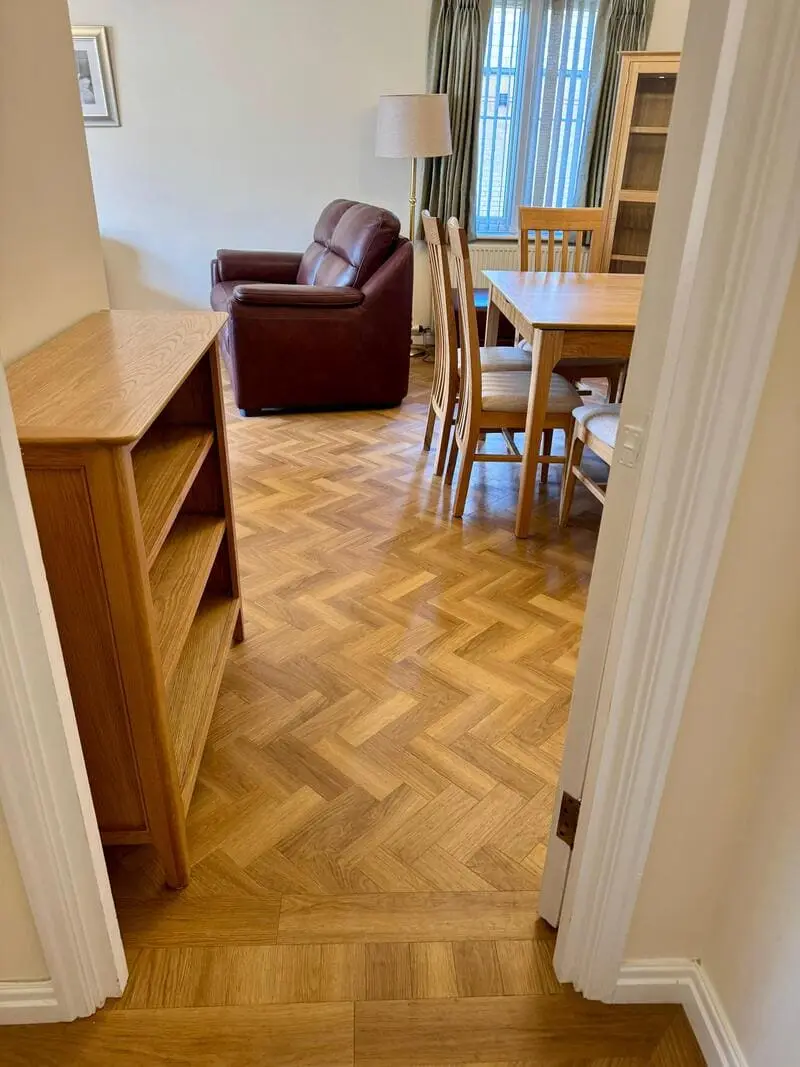 Amtico Spacia Honey Oak small parquet in herringbone with a plank-on-edge border, laid over a Jumpax subfloor system in North London. See the job, Ref 13439
How long does screed take to dry?
This is the question everyone asks, and the honest answer is that it depends: on the product, how thick it goes down, the room and the weather. We will advise you on the day rather than give you a figure in advance. The new floor only goes down when the screed is ready.
If you have a new extension, tell us when the builder’s screed was laid. A new sand and cement screed holds a lot of water, and we will want to be sure it is dry enough before anything is glued to it. It is worth raising early, while you are still planning the kitchen, so the flooring can be booked at the right point.
Is screeding included in the price?
Preparation is part of the job, so it is part of your written quote. As a guide, Amtico itself costs from about £30 to £130 per square metre, plus fitting at about £30 to £60 per square metre depending on how complex the design is. We look at the subfloor before we quote, so you know what preparation your floor needs from the start.
Book a design consultation with Russell
If you are planning Amtico or Karndean, come and talk to us before the kitchen goes in. Book a free design consultation with Russell in the showroom at 774 Green Lanes, Winchmore Hill, and bring your plans. Our own fitters do all the preparation themselves, from the screed to the last cut. Book online or call us on 020 8360 1836.