
Yes, a stair runner can go up winders and round a turning staircase. A turn needs two visits: one to template the stairs, and one to fit the runner once it has been made to follow them. Allow £150 to £300 for the extra visit, depending on how complex the turn is. Stair rods on the turn help disguise the joins.
Winders, quarter landings and two flights
Not every staircase runs straight from the hall to the landing. The turns we see most are:
- Winders. Tapered steps that take the stair round a corner. Each one is narrow at one end and wide at the other.
- Quarter landings. A flat landing part of the way up, where the stair turns through a right angle.
- Two flights with a landing. Common in bigger houses, where the runner carries on up a second flight or across the landing.
On a straight flight the runner simply runs from step to step. On a turn it has to change direction, and that is where the extra work comes in.
Why a turn needs two visits
On a straight flight we measure, the runner is made, and we fit it. On a turning stair we come out first to template the stairs, which means recording the exact shape of every winder and landing. The templates are sent away with the order, the runner is made to follow them, and then we come back to fit it.
That extra visit is what the £150 to £300 covers. It is also why a turning stair is worth planning early. A runner takes three to four weeks from order to fitting, and the templating visit comes first.
Examples on winders
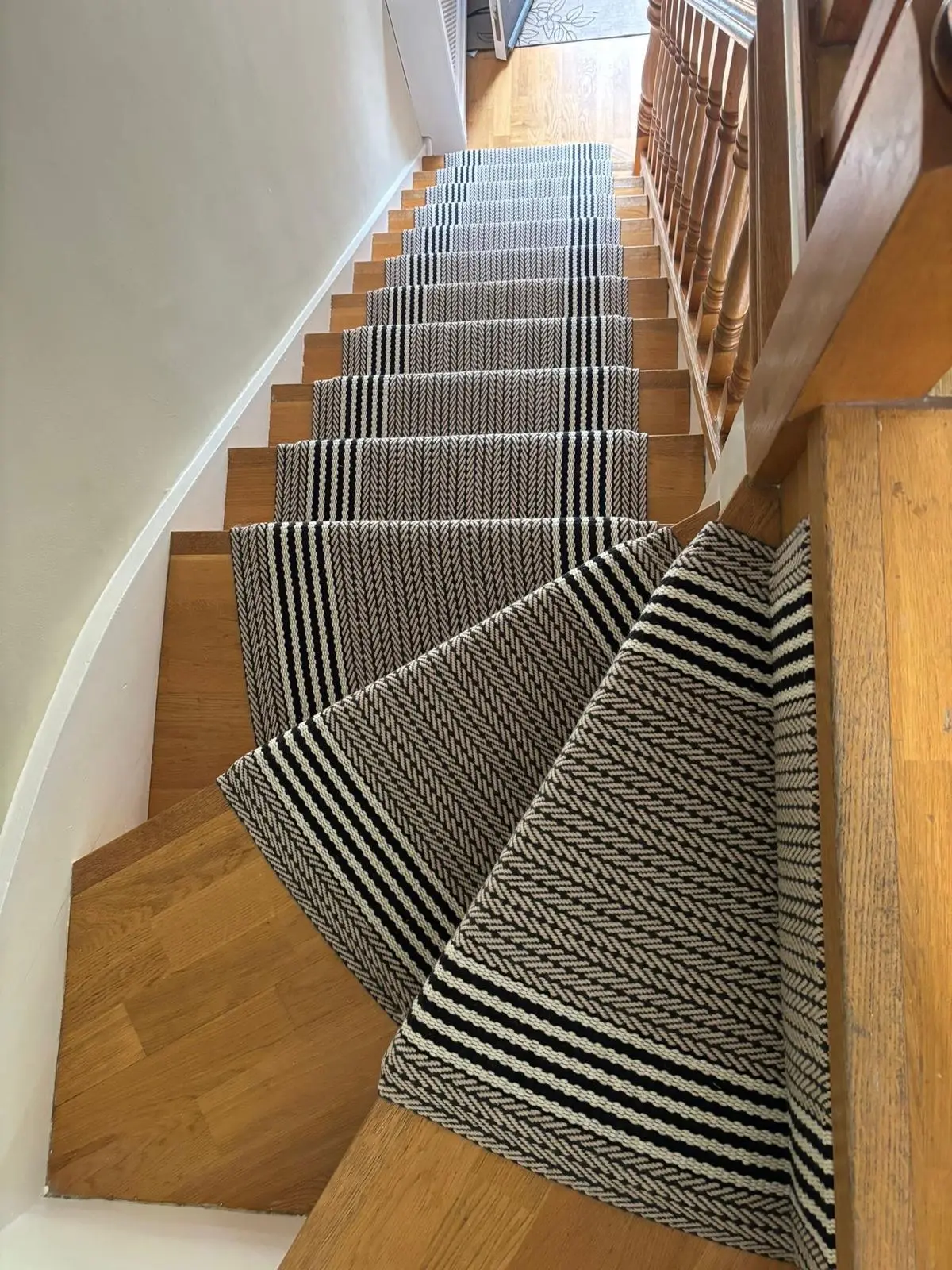
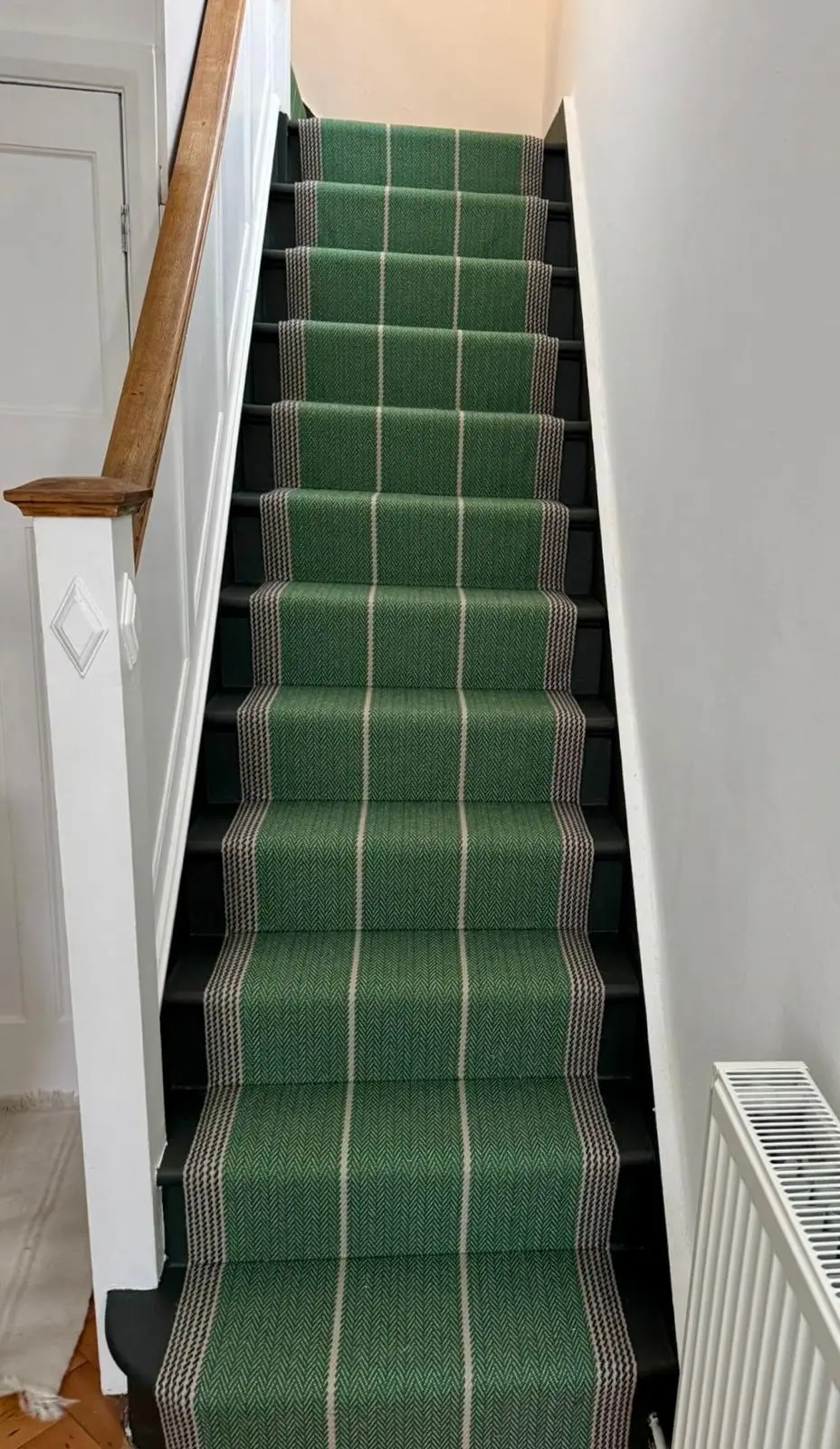
The Roger Oates Flaxman Stone runner at the top of this page shows what a templated runner looks like on winders: the stripes follow each tapered step round the turn.
In a Victorian house in Winchmore Hill, N21, the owners chose the Roger Oates Sudbury runner in Lichen. It runs up the flight and round three winders, and it had to follow each one closely to keep the stripes looking right.
The stairs were finished with Jubilee stair rods in antique brass, and Victoria Carpets Tudor Loop was fitted to the landing. See the Sudbury job, Ref 13220.
Example: mitred at the quarter landing
At a quarter landing, one way to turn the corner is to mitre the runner: cut it at an angle and join it, so the design turns neatly through the right angle.
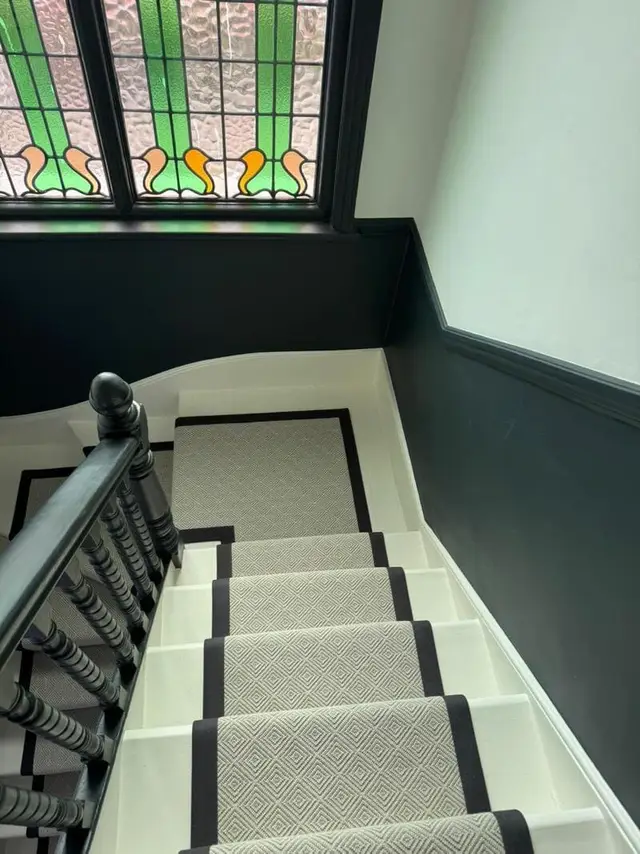
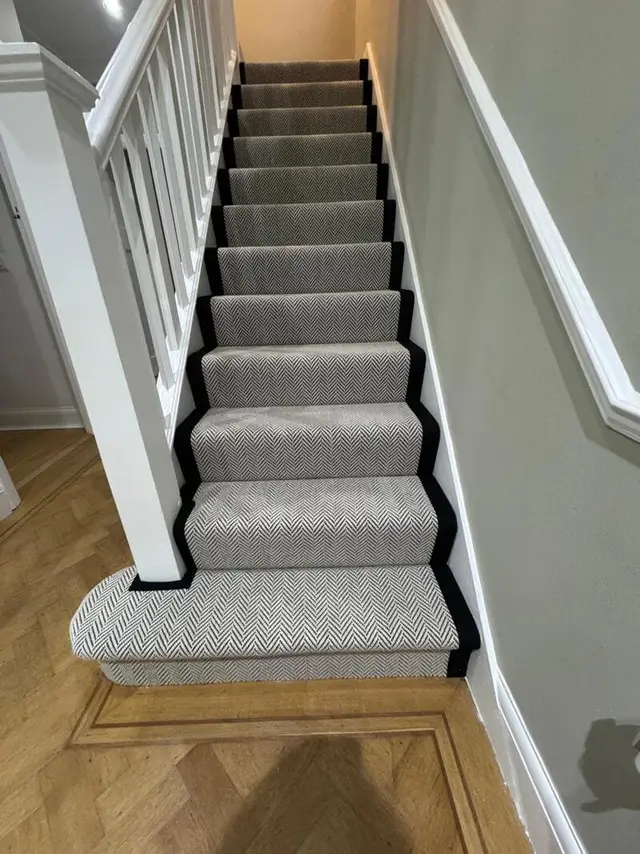
In Southgate, N14, we fitted the Roger Oates Swanson runner in Juniper against dark painted stairs and skirting, mitred at the quarter landing. In Palmers Green, N13, a Roger Oates George runner in Black, 62cm wide, was mitred to the quarter landing and finished with Jubilee rods in antique brass.
 Roger Oates Swanson in Juniper on dark painted stairs, mitred at the quarter landing, Southgate N14. See the job, Ref 13257
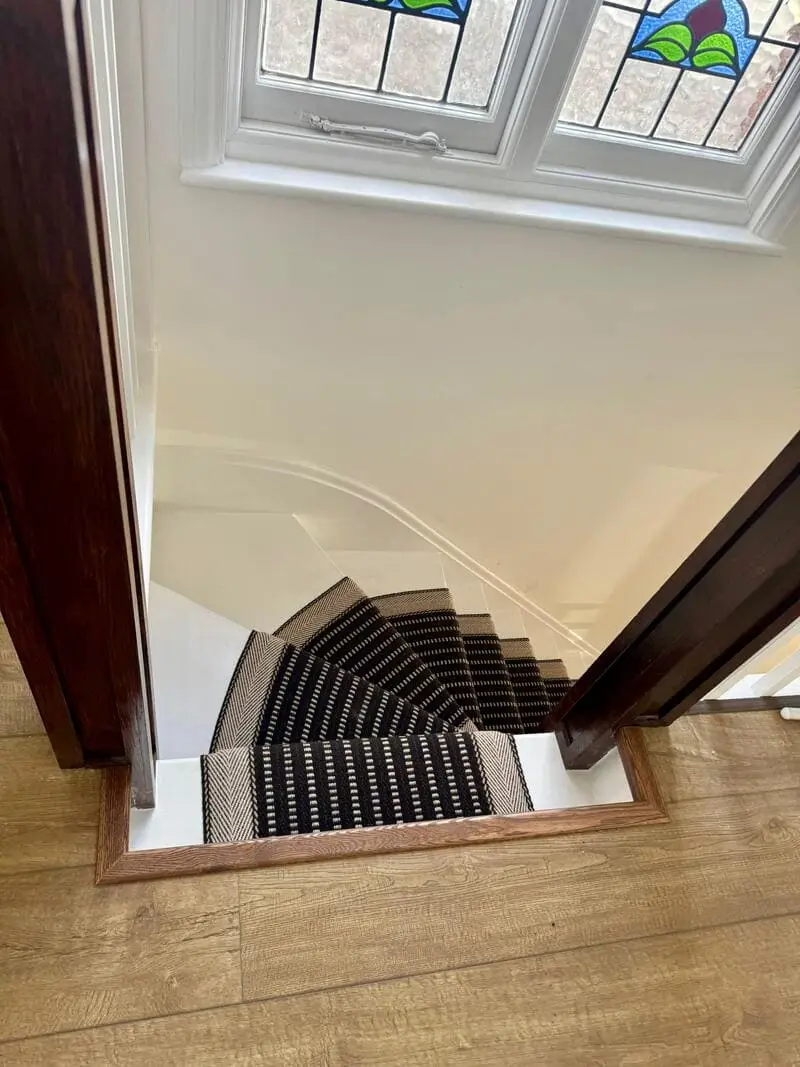 Roger Oates George in Black, 62cm wide, mitred to the quarter landing, Palmers Green N13. See the job, Ref 13345
Two flights and the landing
Some houses have a runner on two flights, with a landing between. You can carry the runner across the landing so the look is unbroken, or fit the landing in a plain carpet. We fitted Roger Oates Flaxman Quartz to two flights of stairs and the top landing, and Roger Oates Fitzroy Midnight to two flights in another house.
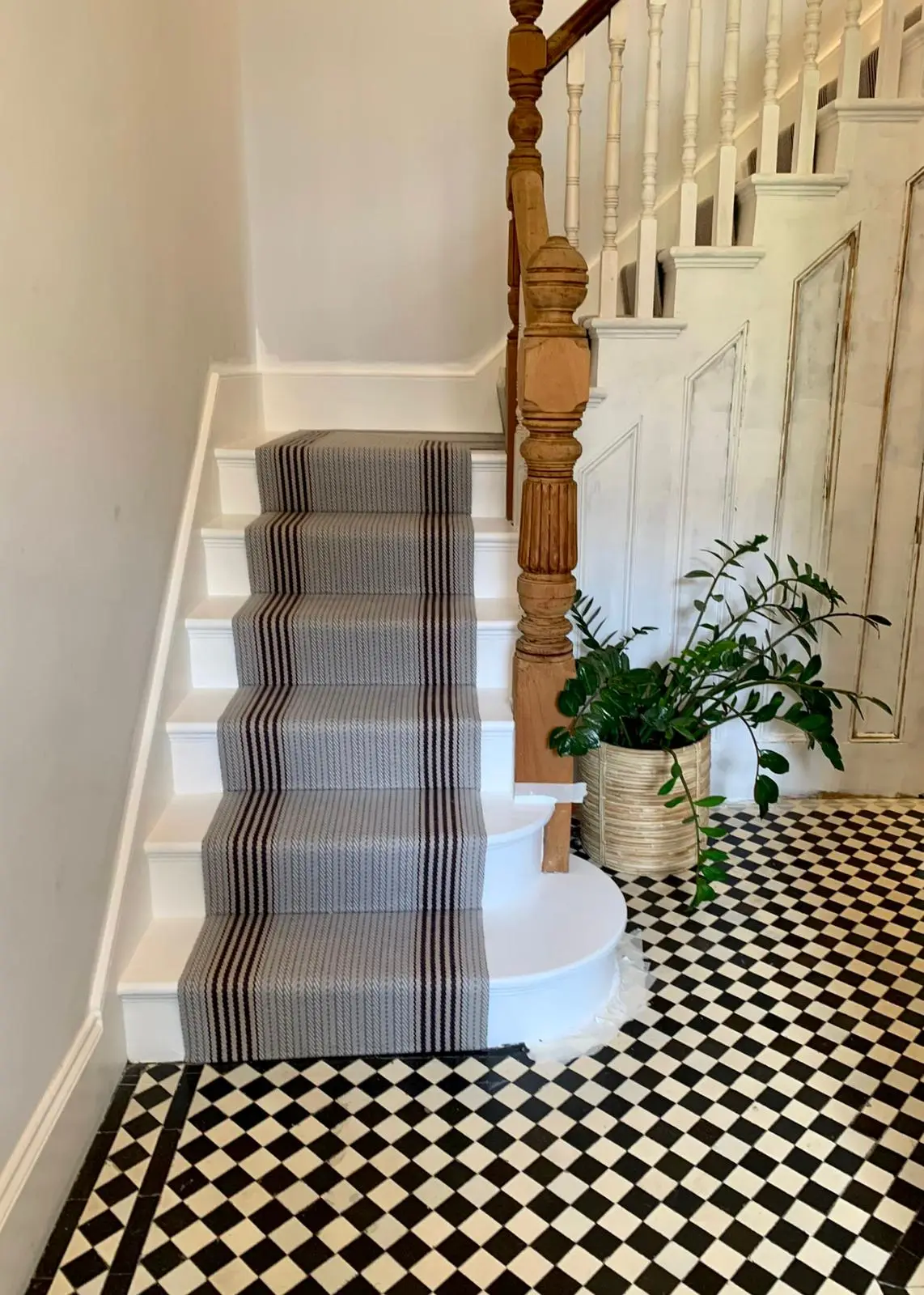 Roger Oates Flaxman Quartz on two flights of stairs and the top landing. See the job, Ref 12278
Stair rods on a turn
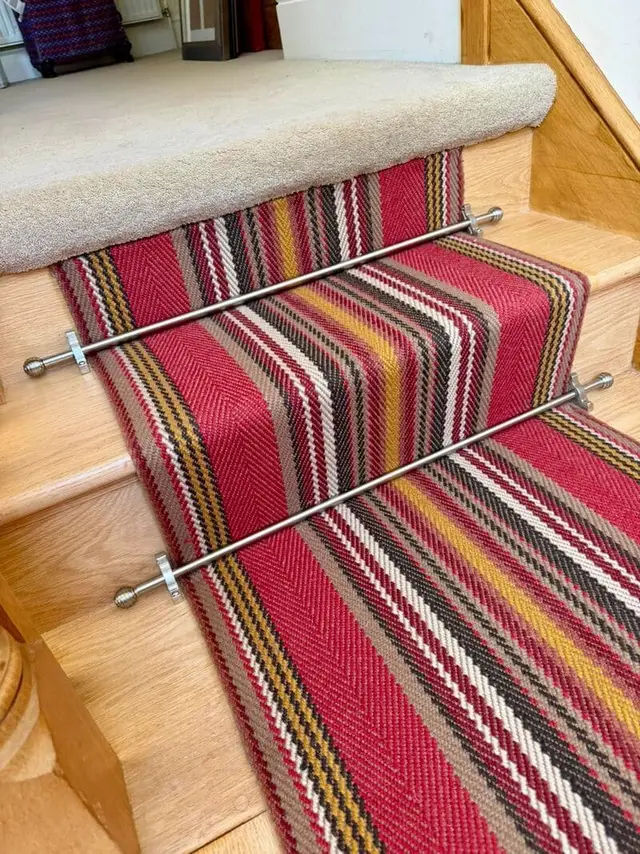
Stair rods are decorative only. The runner is held in place by grippers and a contract double-stick underlay. On a turning stair, though, rods earn their place: they help disguise the joins where the runner changes direction. Our post on what stair rods do explains more, and the stair rods page shows the ranges.
Choosing a design for a turning stair
Some designs are easier to take round a corner than others.
- Stripes. Wide stripes are harder to line up on a turn. Narrower stripes are more forgiving, and rods help too. Our guide to striped stair carpets goes into this.
- Flatweaves and herringbones. These are woven very flat so the design shows, which is why the joins on a turn need care. Flatweave is specialised to fit, so you need a fitter who understands it. Ours do.
- Pile. Whatever the design, choose a low, tight pile or weave. Anything thick or soft wears early on the nosings.
Russell will tell you honestly if a design will work on your turn before you order.
What it costs
As a guide, a runner on 13 straight stairs costs £1,000 to £2,000 with a whipped edge, or £1,300 to £2,300 with a taped edge. A turn adds £150 to £300 for the templating visit. Rods are extra, from about £15 to £60 each plus fitting. Our stair runner cost guide explains what moves the price, and how wide a runner should be covers borders.
Talk to Russell about your stairs
Bring a photo of your staircase, turn and all, to a free design consultation with Russell in our showroom at 774 Green Lanes, Winchmore Hill. He will talk you through designs that suit a turning stair, then we arrange the templating visit. Book your consultation or call 020 8360 1836.