
A herringbone hallway works best when the floor and the stairs share the pattern but not the scale: a bold parquet herringbone underfoot, and a much finer herringbone weave on the stair runner. Give each one a clear edge, a border round the floor and a taped edge on the runner, and the two sit happily together rather than competing.
Herringbone has featured on many of our jobs this year, on floors and on stairs. Here is how to put the two together, with real halls and staircases from across North London.
Why herringbone suits a hall
A hall is usually long and narrow. A straight plank floor runs down it like a corridor. Herringbone breaks that up: the angled blocks add interest along the length of the space, and the zigzag draws the eye across it as well as along it.
It is also a sensible hall floor. Laid in Amtico, a herringbone parquet is hard-wearing, quiet underfoot and wipes clean, which counts for a lot just inside the front door. We cover the formats in detail in Amtico parquet: herringbone, borders and pencil lines.
Scale: bold on the floor, fine on the stairs
Two herringbones of the same size, one on the floor and one on the stairs, can fight each other. The trick is to vary the scale. Amtico parquet blocks come in small and large formats, and on the floor the pattern reads at arm’s length. A flatweave herringbone runner has a much finer weave that reads as texture until you are close.
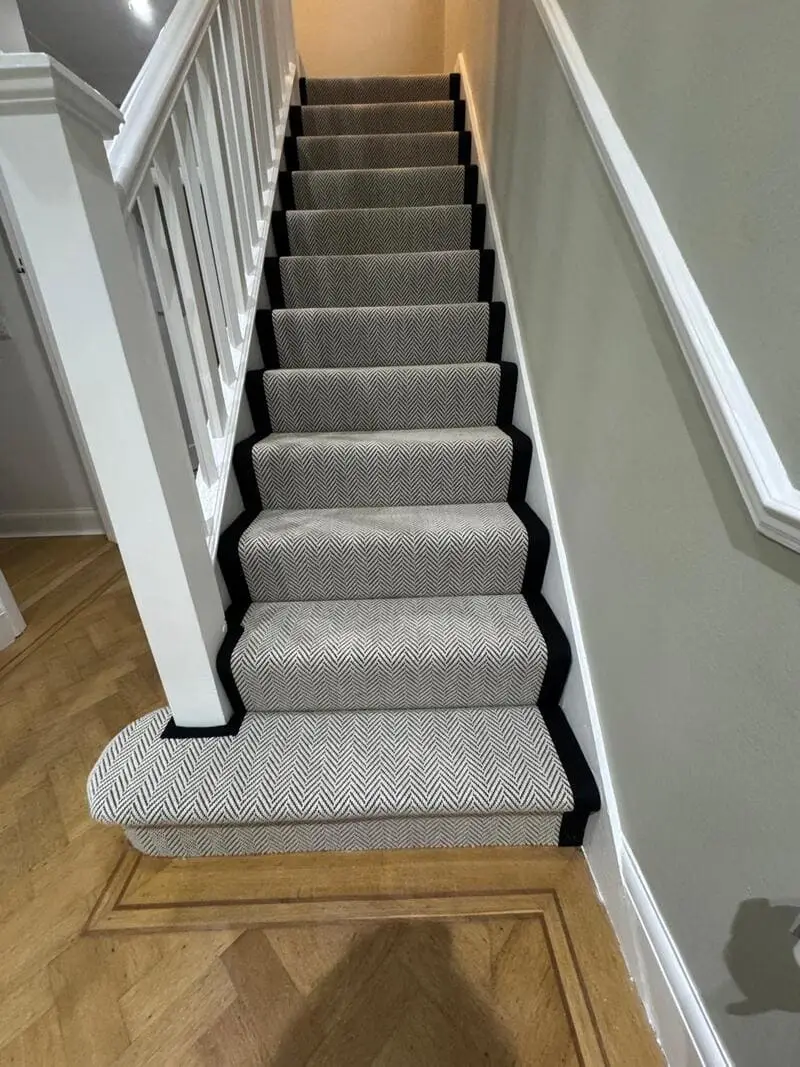
The staircase at the top of this page shows it. A fine Fibre herringbone in Ivory climbs from a hall laid in a larger herringbone parquet with a border, and the black edge on the runner keeps the two patterns apart.
In a Winchmore Hill house in September, we laid Amtico Signature Merbau in large parquet, in herringbone with a plank-on-edge border and a 6mm Teak cross-grain strip, in the living room. On the stairs and landing we fitted Fibre Flooring herringbone flatweave in Zinc. Large, warm blocks downstairs. Small, cool weave on the stairs.
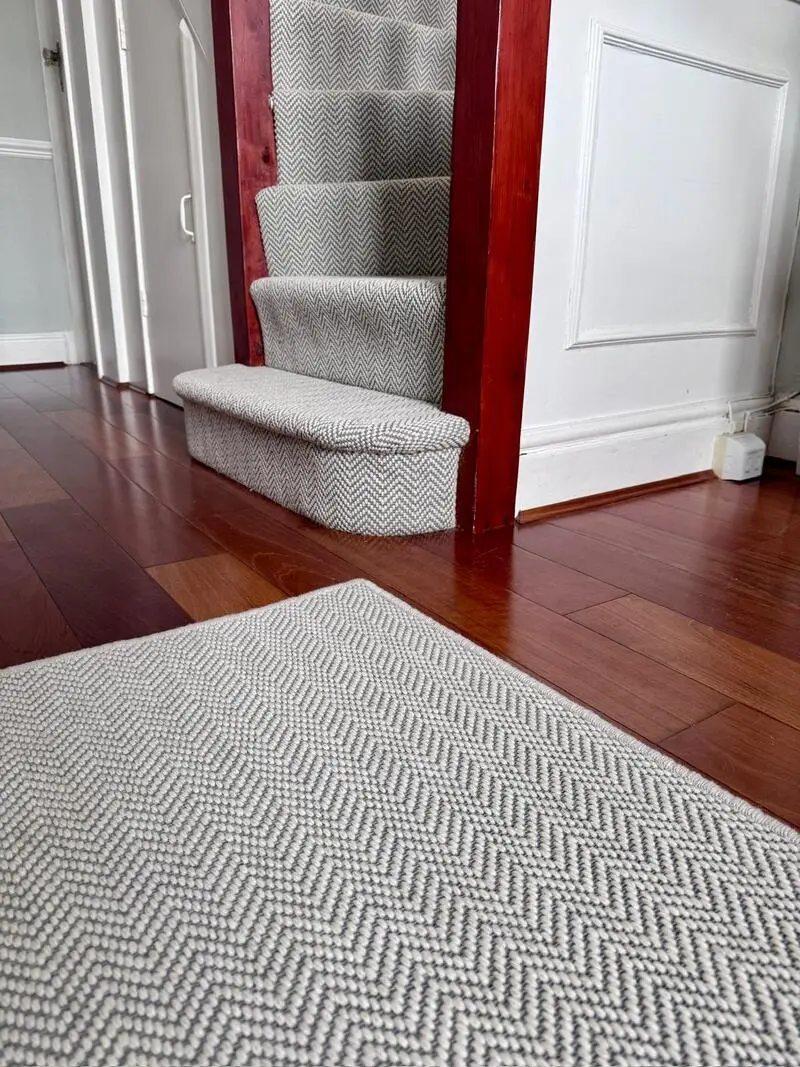 Fibre Flooring herringbone in Zinc on the stairs and landing, Winchmore Hill, N21. The same house has Amtico Signature Merbau herringbone in the living room. See the job, Ref 13692
Colour: warm floor, cooler runner
Most herringbone hall floors are oak tones, warm and golden. Most herringbone runners are greys, stones and naturals. That contrast is useful. The warm floor grounds the hall, and the cooler runner lifts the eye up the stairs.
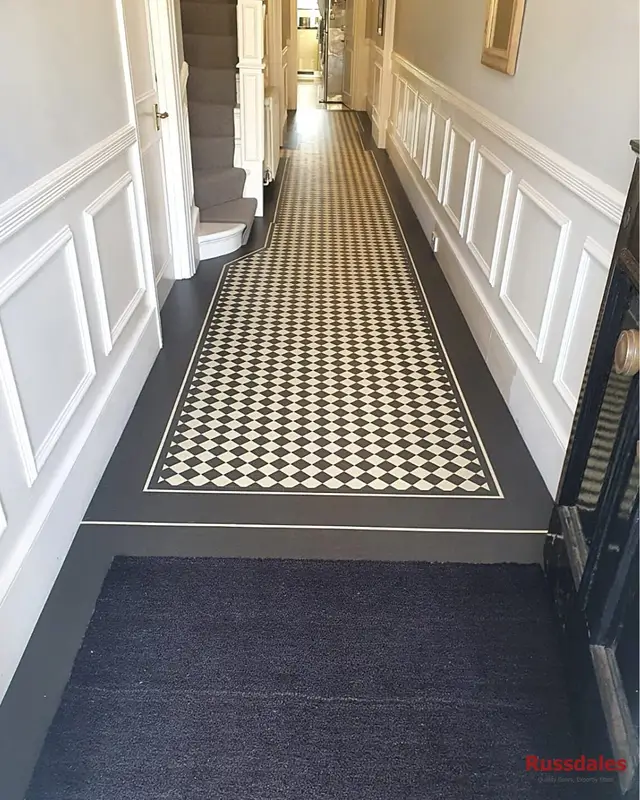
You do not have to match the pattern at all. In one North London hall we laid Amtico Cornish Oak small parquet in a classic parquet layout, finished with a 3mm black pencil-line border, and fitted a Louis De Poortere velvet runner on the stairs with a Marine Blue taped edge and black Jubilee rods. The floor gives the pattern, and the runner gives the colour.
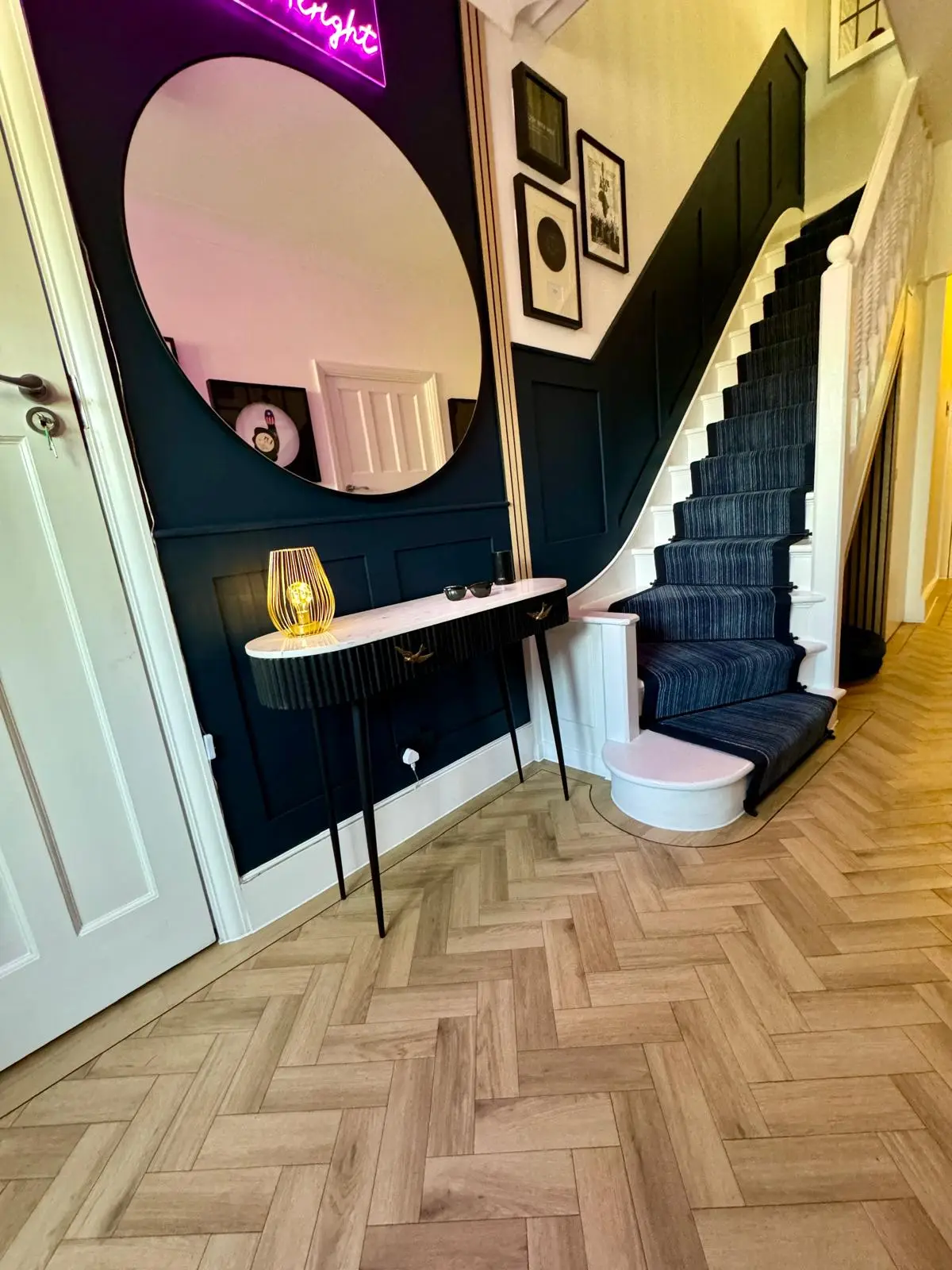 Amtico Cornish Oak small parquet with a 3mm black pencil line, and a Louis De Poortere Milfils runner, North London. See the job
Borders tie it all together
Borders are what make a herringbone hall look finished, and they give you a place to echo the stairs.
On the floor, the main choices are:
- A pencil line: a 3mm strip round the herringbone. We have laid them in black, in Wild Walnut, and in polished brass on an Amtico Form herringbone in Grange Park this spring.
- A plank on edge: planks laid lengthways round the room, framing the pattern like a picture.
- Both together: a pencil line inside a plank border, for a more traditional look.
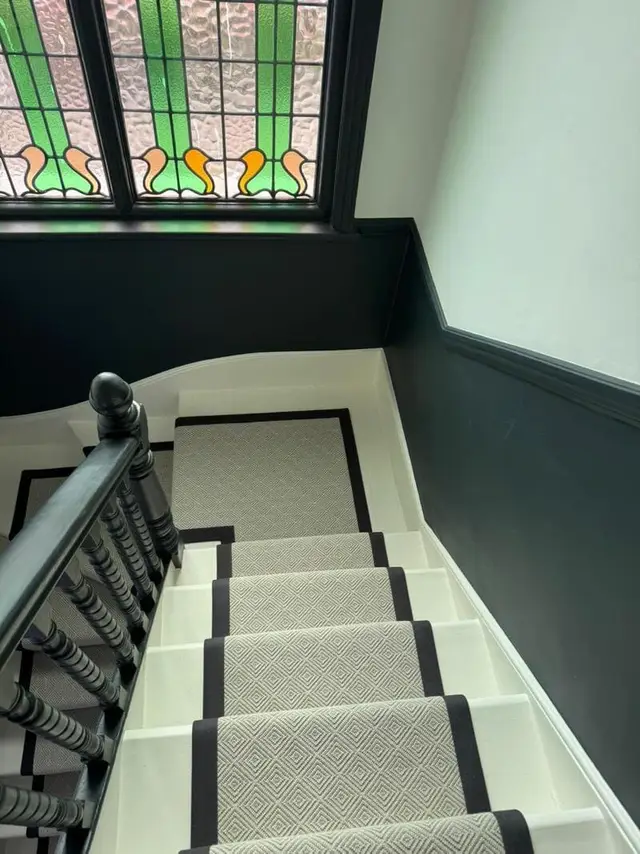
On the runner, the edge does the same job. A taped edge shows about 50mm of fabric, usually in a contrasting colour. Black is the classic partner for a pale herringbone, as on the N14 staircase above. Or pick a colour from the hall: in a Muswell Hill house we finished a Fibre flatweave herringbone runner with a 50mm Tuscan Red edge to go with the patterned Amtico Décor floor at the foot of the stairs. Our guide to whipped or taped edges explains the difference.
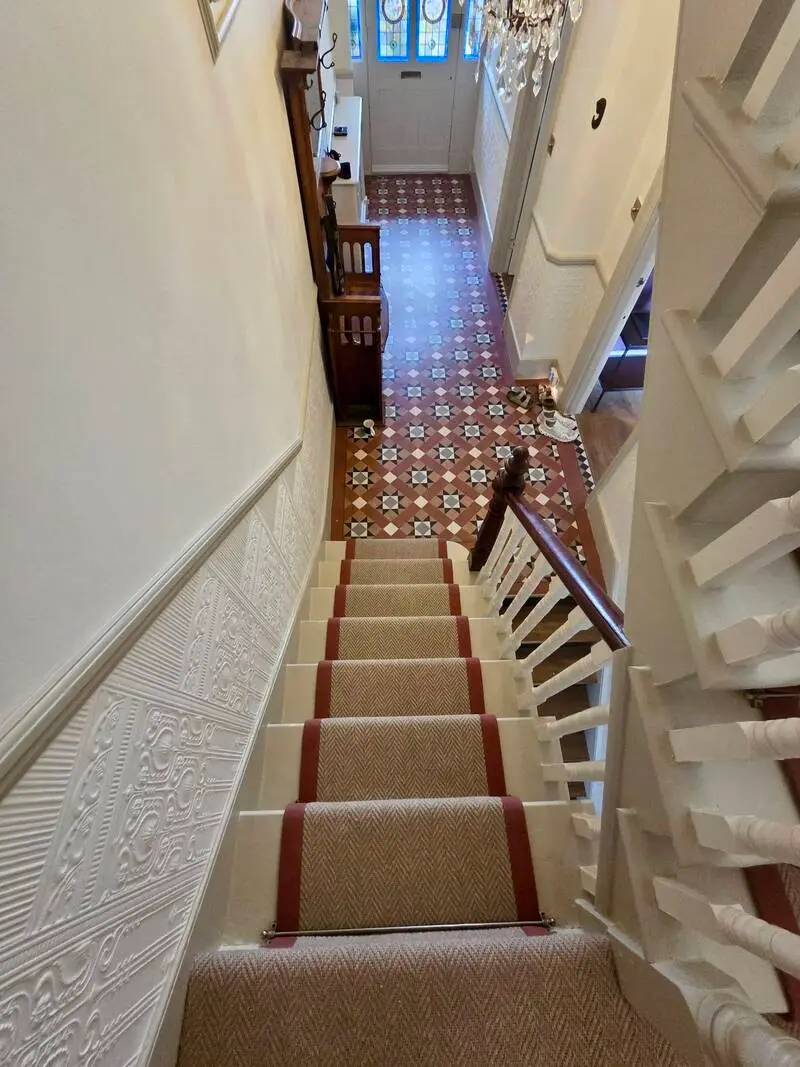 Fibre Flooring flatweave herringbone in Fine Raffia with a Tuscan Red taped edge, over an Amtico Décor Classic Goldstone hall, Muswell Hill, N10. See the job, Ref 13667
Where the floor meets the bottom step
This is the detail people notice. Plan the hall and the stairs together, so the floor border frames the foot of the stairs neatly and the runner lands squarely on it. If the hall floor goes in first and the runner later, tell us about the runner when we set out the floor, and we can allow for it.
If the hall and landing both have carpet, fitting the same herringbone across the landing keeps the pattern running from the top step onto the flat. Our post on landing carpets covers that junction.
Practical points
- Choose a low, tight weave for the stairs. Flatweave herringbone is ideal, but it needs a fitter who knows how to handle it. See flatweave stair runners explained.
- Prepare the hall floor properly. Amtico is stuck down onto a subfloor that has been screeded or ply-boarded until very flat.
- Put a good mat at the door. Grit is the enemy of any hall floor. Our post on coir matting and entrance mats explains why.
For more ideas, see herringbone carpet on stairs and hard-wearing hallway floors.
What it costs
As a guide, Amtico costs from about £30 to £130 per m², plus fitting at about £30 to £60 per m² depending on how complex the design is. Herringbone with borders is towards the more involved end. A runner on 13 straight stairs is £1,000 to £2,000 with a whipped edge, or £1,300 to £2,300 with a taped edge. We confirm everything in your written quote.
Plan your hall and stairs with Russell
Bring a photo of your hall and stairs to our showroom at 774 Green Lanes, Winchmore Hill, N21. Russell can lay Amtico parquet next to herringbone runner samples so you can see the scale and colours together. Book a free design consultation or call 020 8360 1836.